During our discussions, one of the topics we touched upon was high altitude training. When thinking of high altitude training, among the next natural topics should be the usage of high altitude chamber. We agreed that we would try and find one in the area and go through it together.
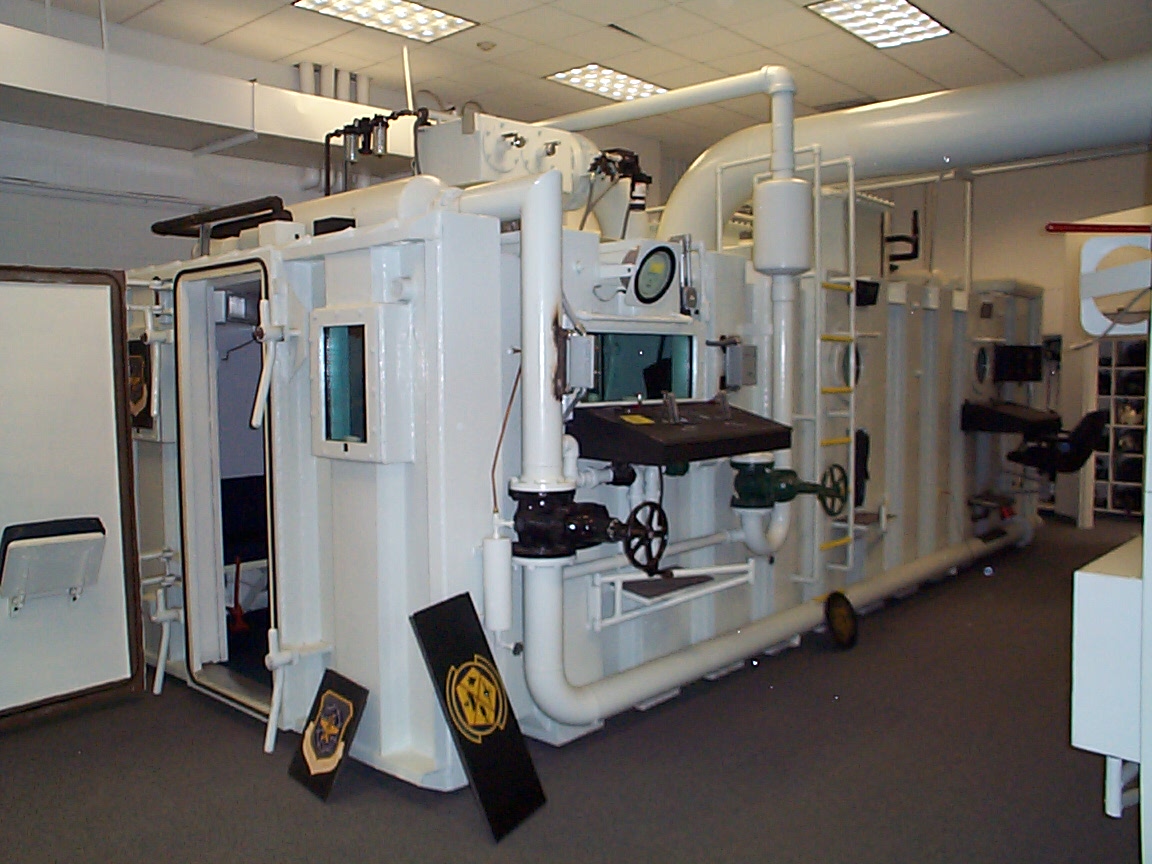
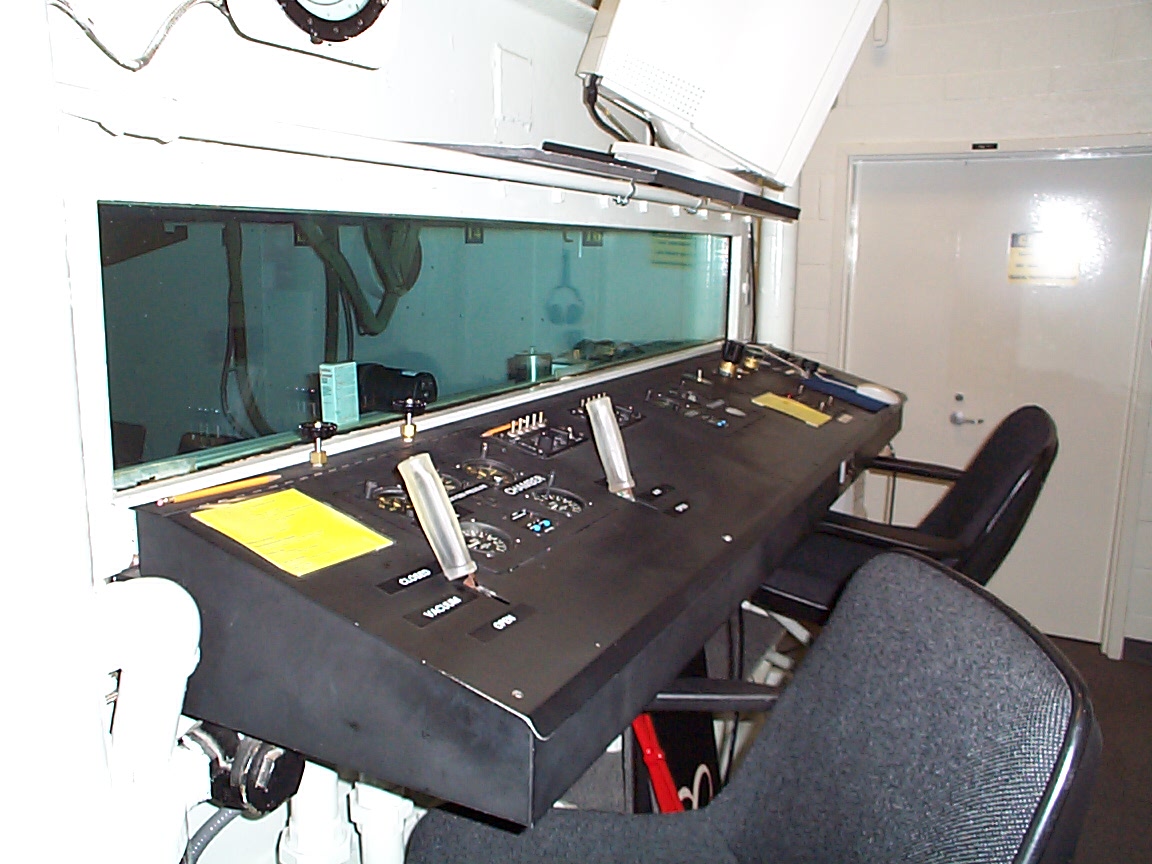
High altitude chambers are an interesting piece of technology. They simulate going to various altitudes without ever leaving the ground. Since, the most significant variable associated with changing altitudes, is the air pressure, a high altitude chamber consists of a sealed container in which the air pressure can be varied, synchronizing those changes to particular altitudes. Reducing the air pressure maps into a higher altitude, increasing the air pressure maps into a lower altitude.
The next step, of course, was trying to find a high altitude chamber and an associated course curriculum. As it turns out, that only took a matter of a few phone calls. A very good altitude chamber is available right here in the Washington DC area at Andrews Air Force Base.
The Andrews AFB course, Physiological Flight Training, is a hands-on course that is part of the regular continual training exercises required for air force pilots. It involves a full day of classroom training with practical exercises in the chamber, high altitude emergency response, spatial disorientation, darkness factors, and even survival training introduction. It is the result of 60 years of experience in the field, in warfare, in times of peace, across a multitude of aircraft types. As if that wasn't enough, this course is the same course which is mandatory for the men and women pilots helping to keep our nation safe. I figured it would do for me and my friend.
This course is made available through a contract with the Federal Aviation Agency for civilian pilots for the ridiculously low sum of $35. A minimum of a class III medical certificate is required. It is only available at certain times and only by prior arrangement. Put this down as a checkmark for the FAA working to help the civilian pilot world.
Members of our 13 person class included VFR-only pilots, IFR pilots, certificated flight instructors (CFI's), certificated flight instrument instructors (CFII's), corporate pilots, light single piston pilots, skydivers, university based flight instructors, and corporate jet pilots (Gulfstream-4).
Getting into Andrews AFB was as easy as having the driver of the car show their drivers license. Once in it was only a short drive to building 1045 where the chamber and classroom was contained. It is part of the extensive medical center facility at the base.
Upon entering the building, we were required to turn in our medical certificates. While we worked on our training during the day, the classroom personnel verified the currency of the certificates and used them in the generation of completion cards.
After a short wait, the first class started. This segment consisted of the basic physiological responses of the high altitude environment. It also consisted of a basic description as to what we were going to do in the chamber.
Symptomatically, we could expect any number of responses. The whole activity for today was to understand what our own symptoms would feel like in an actual hypoxic state. The instructor pointed out that individuals feel their symptoms, in general, the same way every time and that those symptoms can be very, very unique. Some general examples include a euphoric feeling, a light-headedness, dizzyness, vision tunneling, heavy limbs, repetitious activities, and a loss of analytical skills. The instructor even mentioned it wouldn't be crazy to smell peanut butter. Symptoms are always relieved by one or two breaths from the oxygen mask.
Physiologically, our bodies are subject to some varying degrees of stress due to the reduction of air pressure. The most significant aspect is the reduction of the partial pressure of oxygen in the air. Not getting enough oxygen to where it needs to go for whatever reason is called hypoxia. Hypoxia can be caused by the lungs inability to transfer oxygen into the blood, by the blood's inability to transfer oxygen properly to tissues that require it, or as in our soon to be case, by a lack of oxygen in our environment.
The first hypoxia case is when the lungs are damaged in some way. All of the participates in this training were healthy people so this wouldn't be the case. Imagine damaged lung tissue, or even tissue which is covered by phlegm due to a cold.
The second case is always a factor and should be taken into account. The active ingredient in the blood for the purposes of oxygen transfer is hemoglobin. In a odd twist of fate, it has a 250 times affinity for carbon monoxide (CO) than it does for normal atmospheric oxygen (O2). When a CO molecule latches onto a hemoglobin molecule, it's latched on for good. And that's bad because now there's no room left over for the transport of O2. This is of an important nature to the pilot and the jumper alike because the CO molecule is one of the outputs of any engine. It is colorless, odorless and simply puts the breather to sleep. In particular for the smoker, burning cigarettes also output the CO molecule which affects a body's ability to transport O2.
In addition to hypoxia is something which is well known to certified scuba divers, the bends. The bends is when a reduction in atmospheric pressure results in the release of excess nitrogen from the blood. The resulting nitrogen bubbles will collect and may cause serious trouble to the afflicted including the possibility of death. This is a factor only at altitudes in excess of 18,000 feet, but can be brought on at lower altitudes by other factors including, but not limited to, scuba diving less than 12 hours previously, the flu, obesity, age, or even personal physiology. A person can be afflicted by the bends many hours after the initial cause. In any case, the bends is treated by the repressurization of the affected individual. It is not a bad idea to keep the following scuba diving emergency number handy in situations where the bends is possible: Diver Alert Network (DAN) 919-684-4326 or 800-873-2826.
A more unlikely, but still possible ailment, is also known by scuba divers: an air embolism. This is when the depressurization is very rapid and the afflicted individual cannot remove air from their lungs quick enough to accomodate the change in pressure. The lungs branch off into smaller and smaller air passages until the smallest of the small is reached. These vacuoles are thin enough to convey oxygen molecules through to the blood. A rapidly decreasing pressure may cause them to expand to the point of popping. This will release air directly into the bloodstream, a place where you really don't want it! The real problem is that these small bubbles can cause blockages in the critical blood vessels. Since the first major stop after the lungs is the heart quickly followed by the brain, some fairly life threating damage may be caused.
The last point for this instructor was to discuss what our "flight plan" would be for the chamber. First off, since we would be traveling to above 18,000 feet we would de-nitroginate our blood by breathing pure O2 for 30 minutes. During that time, we would take a quick flight up to 5,000 feet and back down to verify that all systems were working and that our ears were up to the task. Ten minutes before the 30 minutes were up, we would fly up to 8,000 feet and stay there until ready. The significance of 8,000 feet is that it is slightly higher than the altitude that a normally pressurized cabin will be held at. After our 30 minutes were up, our masks would be removed followed by a fast ascent to 25,000 feet. The ascent would be modeled to simulate a sudden decompression of an aircraft. Our jobs would be recognize three or four symptoms of hypoxia and put on our masks. Once everyone's mask was re-affixed, we would travel back down to 18,000 and then see how night vision is affected with a practical demonstration. The chamber flight would then conclude.
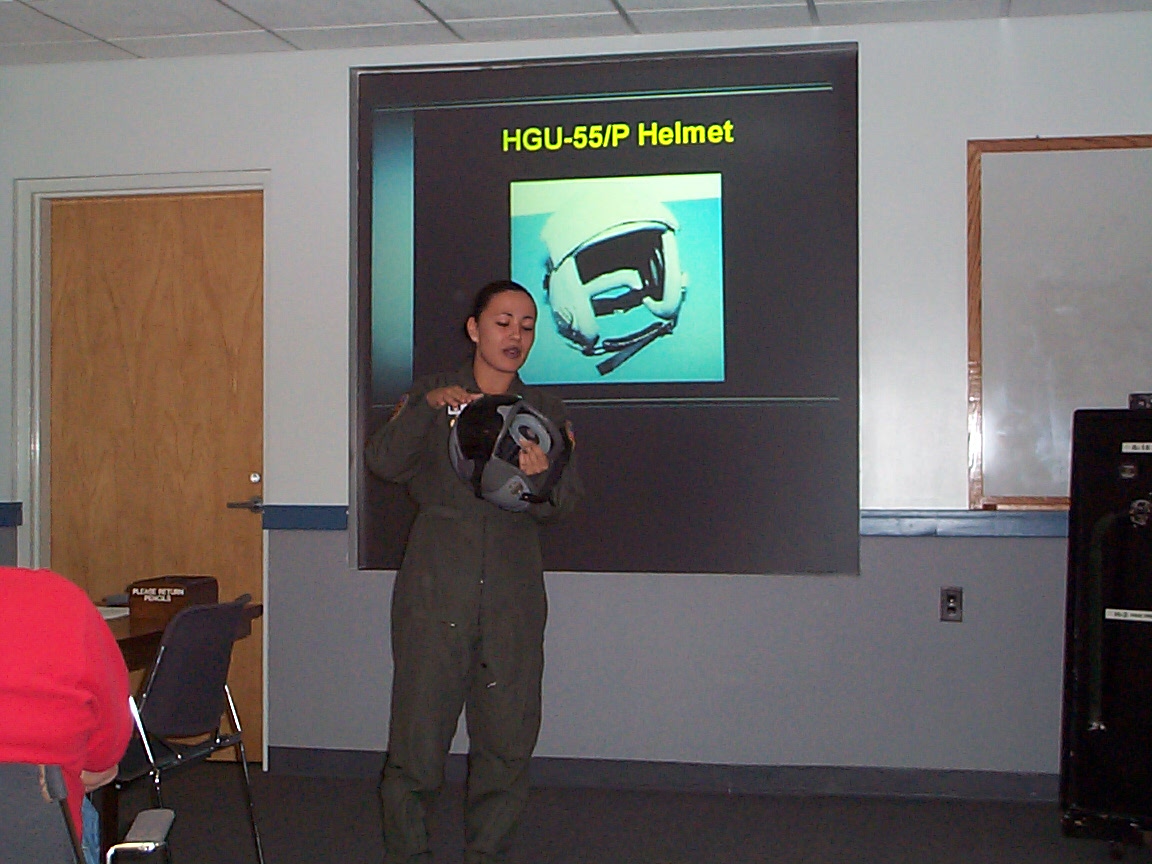
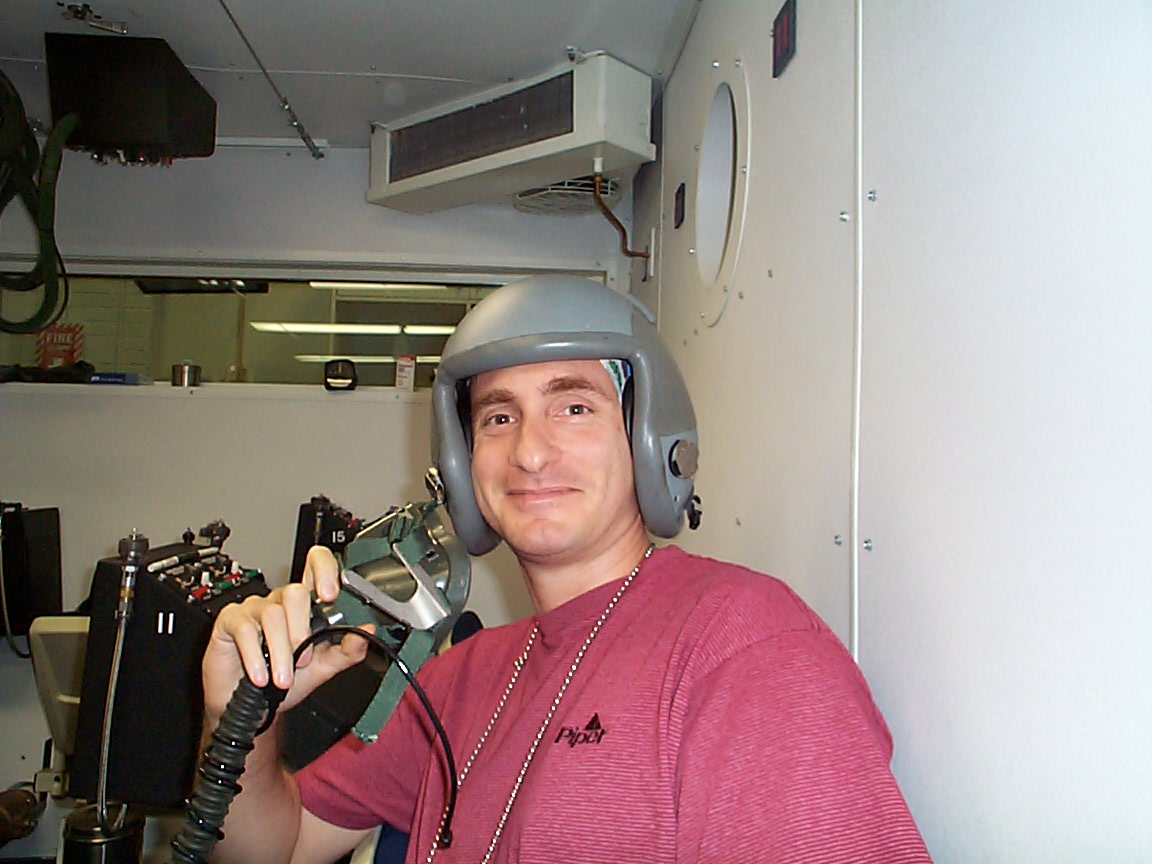
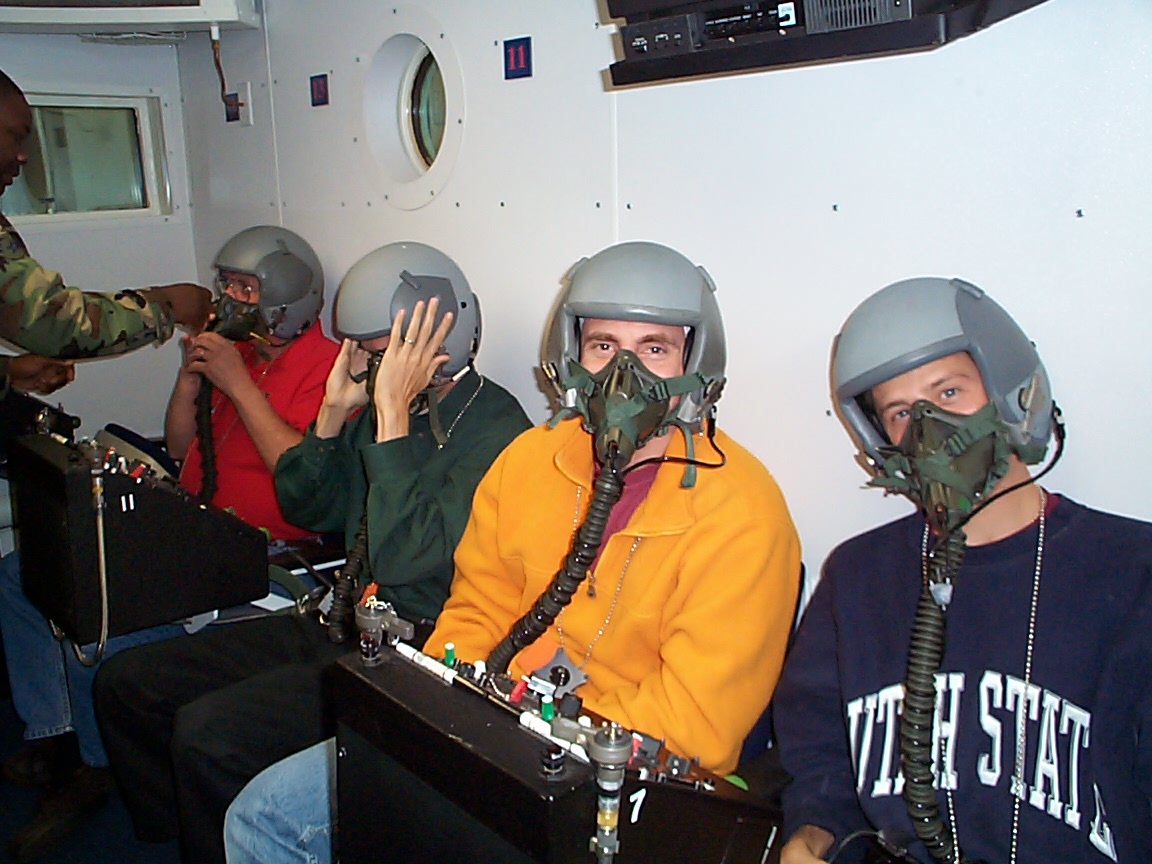
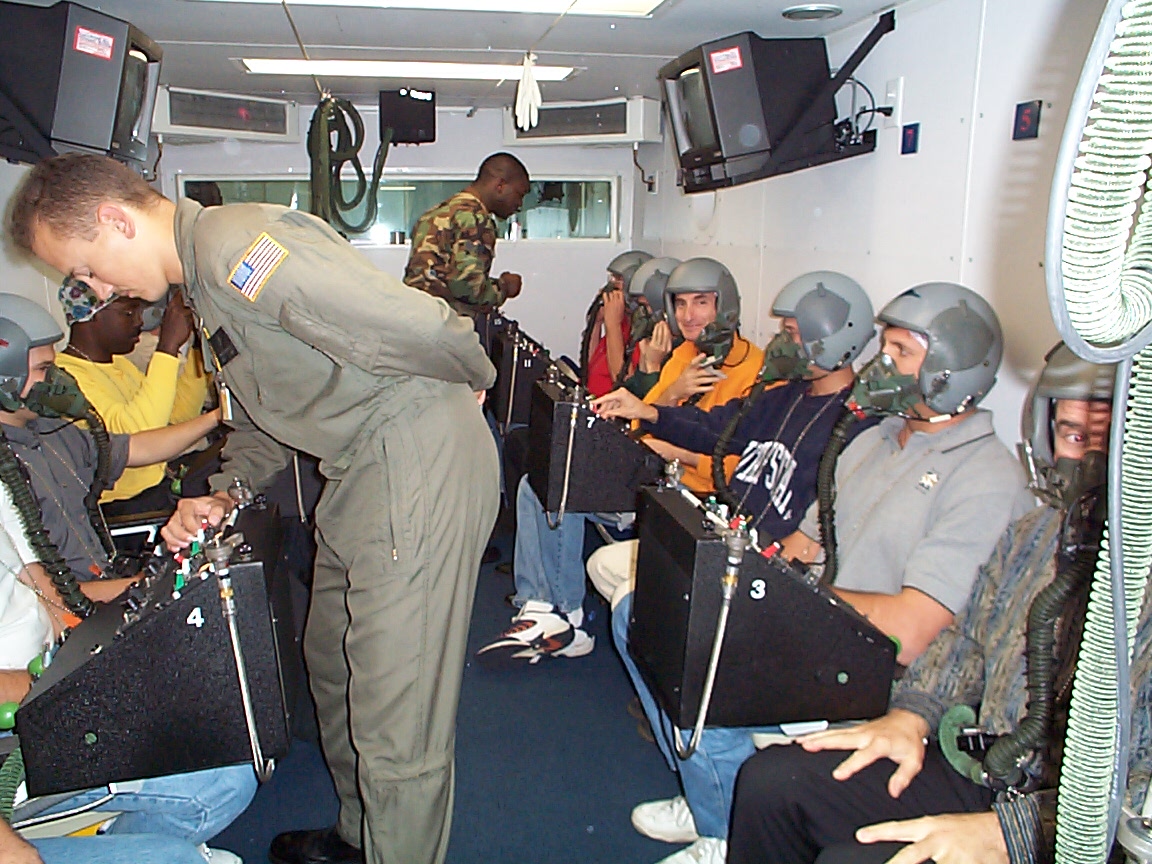
This was all very exciting stuff and I couldn't wait to get into the chamber, but first things first. Another instructor was dispatched to instruct us in the equipment of that the air force uses for their aircraft. The three basic pieces was a helmet with integrated headset (HGU-55/P), a top-gun snake-like air mask, and a connector piece (CRU-6). In addition, the instructor informed us of the basic functions of the oxygen stations and the usage of emergency bottle equipment. The instruction ended with our entire class picking up their own equipment, moving over to the chamber, donning and adjusting airflow and mask/face matings.
After some additional instruction we ready for the ride "up to altitude." It all seemed so real when the huge airtight door was shut. Instructors on both ends of the tank, in their green camouflage fatigues, checked us over and then donned their own oxygen masks. We were aware that breathing "normal" air for just one two breaths would be enough to force us to restart the 30 minutes denitrogenation process. Breathing wasn't as easy as I thought it would be. A good long suck was required to get the right amount of air into my lungs. Periodically, a long sustained suck was required to get the right amount of air. When in an "emergency" mode, the flow was continuous and the reverse was true, meaning air was practically pushed into your lungs and the exhale took a bit more effort. The altimeter in the corner of the room started to move at a rapid up rate and the 30 minute clock was ticking.
After going to 5,000 feet and back down with no ill side affects by anyone in the group, we waited out the remaining denitrogenation time by watching a video taped program with interactive elements from the instructor. Elements of this instruction include different types of aircraft pressurization systems and some short interactive quizzes.
The final "boring" part of the flight was the flight up to 8,000 feet. We leveled off there until the remainder of the 30 minutes were up. The instructor told us to remove our masks at this time. This was followed by a fairly rapid ascent to 25,000 feet. Watching the altimeter move up was a thrill, but there was no somatic sensations revealing the evacuation of the high altitude chamber of the air save for two notable exceptions. The air dropped in temperature very noticeably as we climbed. The other was when the visibility in the room dropped quickly when the room atmosphere turned into a cloud for a short time.
Our goal was to see what our personal reaction to a dramatic reduction in the oxygen intake of our bodies would be. Previously, we were given a clipboard with some activities to perform at altitude. I started on mine. At first there was nothing. The first thing that I noticed was that my vision was getting "grainy." I could still see fine, but everything appeared courser. My arms started to feel heavy. My vision got worse. I started to get lightheaded. My analytical skills worsened. Perhaps my time sense started to be skewed. I flipped up the emergency air flow switch as we were previously instructed to and then latched my mask onto my face. Within two breaths everything was clear again. I looked around.
At this time, the instructor was working with the remaining students. He was telling them to lock their thumbs together and to pretend to be an airplane. Now you're climbing, now, you're descending, banking. The person next to me was really wasn't following along correctly. The instructor noted this by commenting that he had descended into the mountain. It was kind of funny sitting there watching these grownups failing at trivially easy activities. Most folks had put on their masks at this time. The person next to me was getting special attention from the instructor at this time. He was instructing him to put his mask on with no extra strength in his voice. Still the student did nothing. He kind of looked around like it was just everyday business: "what are you looking at me like that for?" The instructor then instructed him to put his mask on or he would die. The student just sat there. It was very instructive. One of the instructors calmly walked over and flipped on the emergency switch and affixed the face mask to the helmet. I made a mental note to ask this student about his experience later on.
With everyone back on oxygen, we started our descent, being careful to allow enough time for ears and sinus' to clear. It was hard to valsalva through the mask, but the alternative wasn't pleasant. At 18,000 feet we stopped, blacked out the chamber, and illuminated with simulated cockpit lighting to simulate a night flight. The instructor asked us to remove our masks again. This time we were going to see how the fovia was affected by a shortage of useful oxygen. Turning over the clipboards revealed colorful diagrams with a fixed object in the center. The experiement was supposed to show how the object could be made to disappear in the right conditions. Unfortunately for me, I was never able to get it to disappear. In fact, my vision went grainy only after I put my mask back on, which was odd. This time we continued down to ground level air pressure and exited the chamber.
We were still not done with the whole class yet though. After a quick debrief, we went on to get lunch and continue on. Note to self, the next time taking the physiological flight training classes don't eat Burger King. Second note to self, don't volunteer to be a guinea pig for the demonstration. The next step was spatial disorientation.
During lunch I had the opportunity to ask that spaced out student what he was feeling while he was hypoxic in the chamber. He said that he heard aboslutely everything that was going on around him. There just was a disconnect between the words, "you're going to die unless you put your mask on," and the action to do so. He put it succintly by saying it was "weird."
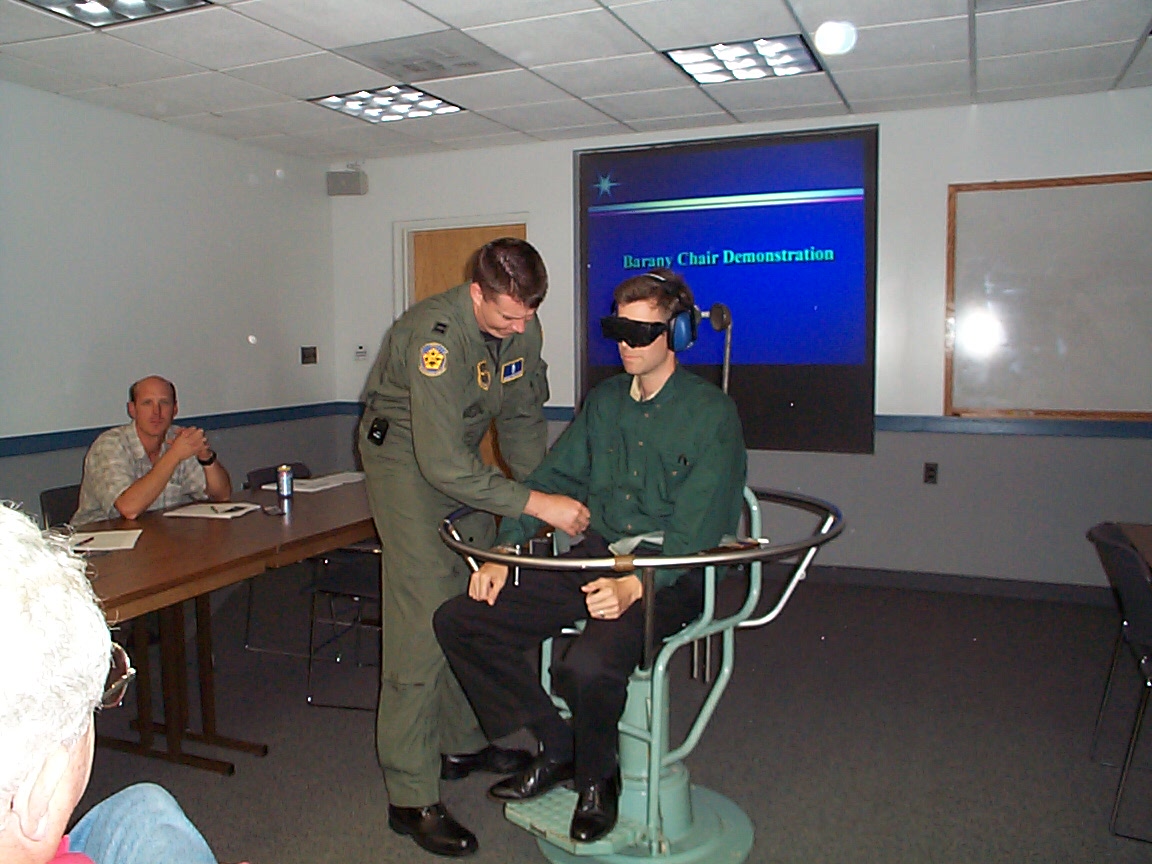
This class included a Baraney Chair. It was essentially your basic rotating chair sitting on ball bearings. The instructor can spin it quickly or slowly to show how the normal somatic sensations from your inner ear can be fooled. I'm feelin just a little bit queasy justing thinking about how I was feelin then. The instructor for this portion required several guinea pigs. The first one was a simple persistance of motion sample. A student was masked, muffed and turned very slowly. The students action was to point in the direction of the turning. It was pretty amazing, but after a while, the student was fooled into thinking they were turning in the opposite direction in which they were actually turning. It was eye opening. The other demonstration included one in which the world spun rapidly even after sessation of movement with incredible eye jitters, a severe sensation of falling over forward, and another one of a severe spining over backwards (mine). The student that got up before me put it best: "that didn't feel good." It was the closest I've been to throwing up in decades.
The final instruction area was in darkness adaptation. For this area some folks were asked to volunteer to wear dark adaptation goggles (basically red goggles). We killed 15 minutes wandering around while the staff there blackened the room completely, some of us closer to the bathrooms than the others. Once in the room, the lights were cut off and it went black. A special variable light projector was turned on. It showed various objects on the wall. The folks with the night adapation goggles actually saw something on the wall. That was with having the benefit of only 15 minutes of goggles. The instructor went on to say that certain chemicals in the eye are drained with bright sunlight. Even wearing regular sunglasses during the day would decrease the amount of time required to become accustomed to darkness. I only wish I could have paid more attention to this while I suffered in the darkness with my queasy stomach! It was fascinating stuff.
In fact, the whole course was fascinating. I had originally went there to experience just the chamber and see what my personal physiological responses would be (and just for the sheer coolness of it), but it turned out to be quite a bit more. It was enjoyable and resulted in the passing of some very useful experiences which I hope to never have to put to the test, but knowledge is power in skydiving and in flying.